

Unless you are living under a rock instead of on ours, you certainly watched (or at least heard about) the Artemis 2 space crew's spring flight around the moon. We're all aware of the years of planning, training, equipment testing, mapping, and calculations that go into preparing for human-piloted space flight, but have you ever stopped other think about. the software all that preparation takes place on?
Today we pay our respects to the woman who did.
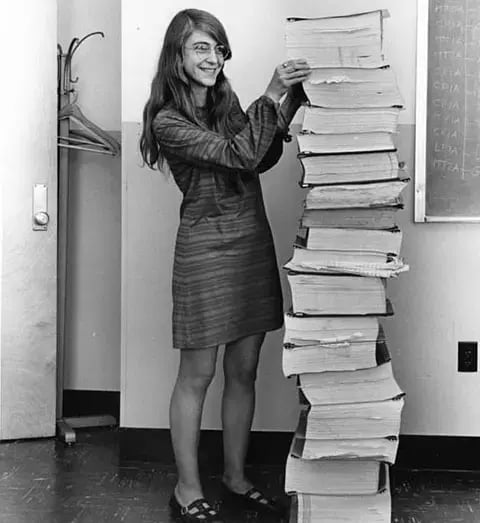 Margaret Hamilton standing next to books of code for the Apollo Guidance computer, MIT Instrumentation Lab, 1969 (nasa.gov)
Margaret Hamilton was a mind for the ages, Having earned a job at NASA, she quickly became the leader of the team that was developing the software for the Apollo mission...by hand. The story goes, her daughter was playing in the flight simulator and "crashed" the module by launching a program mid-flight. Hamilton had already been rumination on scenarios like this and this sealed it for her.
Hamilton insisted that training astronauts was not enough, mistakes could (and would) be made, and she demanded the code by prioritized and tested and respected to the to the extent that the hardware was. This is when she coined the term software engineering.
And wouldn't you know it, Margaret was right. On July 20, 1969, as Apollo 11 approached the moon, alarms started sounding on board; the computer was overloaded. Thanks to Hamilton's rigor in developing the code in the on-craft computer, the computer did what she had programmed it to do - it deprioritized the nonessential tasks and focused on the landing, bringing Neil Armstrong and Buzz Aldrin safely down to the surface of the moon. Margaret Hamilton had saved their lives and took the United States to the moon.
Hamilton's conviction now runs through nearly every technology we touch. Your phone keeps working when one app crashes, your car's computer prioritizes braking over the radio, hospital networks fail safely and recover. Each of these and countless others rely on the ideas her team proved under the highest stakes imaginable; plan, prioritize, recover. Plan for human error, prioritize tasks, and design systems that recover instead of collapse.
She later founded her own companies to carry that thinking forward. In 2016 she received the Presidential Medal of Freedom, a fitting honor for someone shows name most people had never heard.
For young women entering software engineering and other technology disciplines, let Margaret Hamilton's career guide and reassure you. She led when leadership was rarely offered to women, and she did it by being indispensable. Every woman who now engineers a system, writes miles of code, or pioneers a program, walks a road Margaret helped clear.
The Moon landing is remembered for its footsteps, but we must also remember the woman who made sure we reached the ground, and who taught us all that software engineering is human engineering.
Inspired by Margaret Hamilton? Build your future in software engineering at UAT. Learn More.


/UAT-Logo-new.jpg?width=151&name=UAT-Logo-new.jpg "UAT-Logo-new")
Comment