


National Pneumatics Day is a time to recognize the innovative systems that use compressed air to power automation, manufacturing, and modern technology around the world. From assembly lines to robotic systems, pneumatics play a vital role in creating efficient and reliable solutions across countless industries. At University of Advancing Technology, students interested in the future of Robotics Engineering and automation can explore how technologies like pneumatics connect to robotics, intelligent systems, and hands-on innovation. Robotics professor, Dr. Matt Prater elaborates on pneumatics and the impact they have on robotics.
For decades, computation has been synonymous with electronics—transistors switching billions of times per second on silicon chips. But a trio of recent research efforts challenges that assumption at a fundamental level. Across microfluidics and soft robotics, researchers are demonstrating that computation doesn’t need electrons at all. Instead, it can emerge from air pressure, flexible materials, and carefully designed physical interactions. Together, these three papers outline a compelling new paradigm: pneumatic computing, where logic, memory, and control are embedded directly into physical systems.
At the heart of this work is a simple but powerful idea: pressure can represent information. In pneumatic systems, a vacuum might represent a logical “1,” while atmospheric pressure represents “0.” Using networks of channels and valves, these pressure differences can be manipulated to perform computations analogous to digital circuits.
The first paper, focused on pneumatic computers for microfluidic control, shows how this concept can be used to build fully functional computing systems without electronics. By arranging microfluidic valves into logical structures, the researchers implemented Boolean operations and finite state machines (FSMs)—the same building blocks used in digital electronics.
What makes this especially impactful is the application. Microfluidic devices, often used in biomedical diagnostics and chemical analysis, typically rely on external electronic controllers to manage fluid flow. These controllers add cost, complexity, and bulk.
By embedding pneumatic logic directly into the chip, the system becomes self-contained. Tasks like mixing fluids, performing serial dilutions, or executing timed sequences can all be carried out autonomously. In one elegant example, a user advances the system’s state simply by covering a port with a finger—physically interacting with the “computer” itself.
This approach not only simplifies device design but also makes it more robust and portable, particularly valuable in low-resource or field settings. While the first paper establishes the foundations of pneumatic computation, the second and third papers in this study extend the concept into a more dynamic domain: soft robotics.
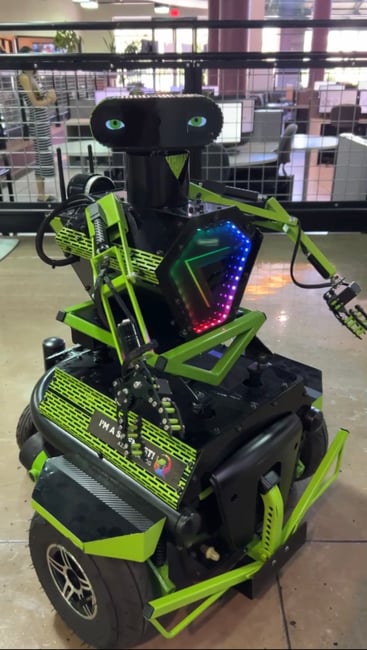
Soft robots differ from traditional machines in that they are made from flexible, compliant materials rather than rigid components. This makes them safer for human interaction and better suited for tasks like gripping delicate objects or navigating uneven terrain. However, controlling soft robots is notoriously difficult, especially without relying on electronic systems. These applications are carried out through coding blocks. Inspired by programming languages, these modular components implement constructs like If statements, For loops, and break conditions—but entirely through physical mechanisms. Instead of lines of code, the “program” is encoded in the arrangement of chambers, valves, and channels
.
A key innovation here is the use of hysteretic valves, which respond not just to current pressure but also to pressure history. This allows the system to exhibit memory—a critical feature for any computational process. With memory, the system can track states, make decisions, and execute sequences of actions. An If condition can be indicated when pressure exceeds a threshold whereas a For loop can be created using oscillating pressure cycles. Finally, a break condition allows the system to exit a loop when a specific physical event occurs. By combining these elements, researchers can design soft robots that behave autonomously, adapting to their environment without any digital controller.
One of the most striking ideas emerging from these papers is embodied intelligence—the notion that a system’s “intelligence” is not separate from its physical form but is instead built into it. In traditional robotics, intelligence resides in software running on hardware. Sensors collect data, processors analyze it, and actuators respond. This separation between body and brain is deeply ingrained in engineering and pneumatic systems blur that boundary.
In one demonstration, a soft robotic gripper searches for an object, detects it through pressure feedback, and transitions to a grasping motion—all without sensors, processors, or code. The behavior arises purely from the interaction of physical components. Another system uses pneumatic logic to coordinate multi-step fluidic operations, effectively “deciding” what to do next based on internal states encoded in pressure patterns. In these systems, structure replaces software. The design of the device determines its behavior, much like how the shape of a key determines which lock it can open.
At first glance, pneumatic computing might seem like a niche curiosity. After all, it is slower and less scalable than electronic computation. But its advantages make it uniquely suited for certain applications such as Operation in Extreme Environments, Simplified System Design, Seamless Integration with Physical Processes, and Accessibility with Portability.
Despite their promise, pneumatic systems are not poised to replace electronic computers anytime soon. They tend to be slower, larger and hard to scale in complex calculations. Designing these systems also requires a different mindset. Engineers must think in terms of physical interactions rather than abstract code, which can make development more intuitive in some ways but more challenging in others.
Together, these papers show that computation is not confined to silicon, but can emerge from the physics of air, materials, and structure itself. By embedding logic directly into physical systems, pneumatic computing opens new pathways for autonomous devices in environments where traditional electronics fall short.
Discover how you can use Pneumatics at UAT, learn more!
References
Ahrar, S., Raje, M., Lee, I. C., & Hui, E. E. (2023). Pneumatic computers for embedded control of microfluidics. Science Advances, 9(22). https://doi.org/10.1126/sciadv.adg0201
Conrad, S., Teichmann, J., Auth, P., Knorr, N., Ulrich, K., Bellin, D., Speck, T., & Tauber, F. J. (2024). 3D-printed digital pneumatic logic for the control of soft robotic actuators. Science Robotics, 9(86). https://doi.org/10.1126/scirobotics.adh4060
Picella, S., van Riet, C. M., & Overvelde, J. T. B. (2024). Pneumatic coding blocks enable programmability of electronics-free fluidic soft robots. Science Advances, 10(51). https://doi.org/10.1126/sciadv.adr2433


/UAT-Logo-new.jpg?width=151&name=UAT-Logo-new.jpg "UAT-Logo-new")
Comment